
Surrogacy Cost in Kenya 2026: Packages, Medical Expenses, Legal Fees, and Success Rates

Surrogacy cost in Kenya in 2026 is a leading destination and a hub for fertility treatments in Africa. This is the location preferred by many. It is the country which remains the safest and most chosen location in Africa. They have all the latest technology and well-equipped hospitals for treatments.
Surrogacy cost in Kenya in 2026 is comparatively less as compared to other countries in Africa. This stays an affordable option for getting treatment in Africa and it remains a feasible option for people travelling from western countries which usually charges prices quite high. In terms of better infrastructure and affordability this stays a better choice for surrogacy treatment.
Going for fertility treatments abroad can be complex and requires deep research while planning for surrogacy or fertility treatment in a foreign country. Be they hospitals, specialists, location, accommodation among others. Each procedure is handled with care and they have an affordable price that works best for international patients.
What is the surrogacy cost in Kenya?
The table given below mentions a complete cost analysis of the surrogacy cost in Kenya. With IVF additional medical and legal procedures are paired for this treatment. Both medical and non-medical staff clinics in Kenya are providing support throughout the journey. The cost of treatment remains quite affordable as compared to other western countries.
| Cost Component | Estimated Cost (USD) |
|---|---|
| IVF Cycle & Embryo Transfer | $3,000 – $8,000 |
| Fertility Medications | $1,000 – $3,000 |
| Surrogate Compensation | $10,000 – $20,000 |
| Prenatal Care & Delivery | $3,000 – $8,000 |
| Legal Documentation & Contracts | $2,000 – $5,000 |
| Agency / Coordination Fees | $3,000 – $10,000 |
| Accommodation & Miscellaneous Expenses | $2,000 – $6,000 |
| Total Estimated Cost | $30,000 – $50,000 |
Surrogacy in Kenya with egg donors
With donor eggs the chances of getting a successful result rises and it is prescribed to patients when the intended mother is suffering from any medical condition due to which their eggs cannot be used for IVF so they are prescribed with egg donors for a successful surgery.
Egg donation and additional cost for surrogacy that adds to the total cost of treatment and raises the whole cost of treatment. Egg donation contributes in raising the overall success rate of the treatment. Since the donor eggs are healthier and of a better quality.
| Donor Service | Estimated Cost (KES) | Estimated Cost (USD) |
|---|---|---|
| Egg Donor Compensation | 80,000 – 150,000 | 620 – 1,160 |
| Egg Donor Screening & Testing | 20,000 – 40,000 | 155 – 310 |
| Egg Donor Medications | 50,000 – 90,000 | 390 – 695 |
| Complete Donor Egg IVF Program | 450,000 – 750,000 | 3,500 – 5,800 |
| Local Donor Sperm | 25,000 – 50,000 | 195 – 390 |
| Imported Donor Sperm | 60,000 – 120,000 | 465 – 930 |
| Sperm Bank Access Fee | 10,000 – 20,000 | 75 – 155 |
| Donor Sperm Utilization Fee | 30,000 | 230 |
| IUI with Donor Sperm | 50,000 – 90,000 | 390 – 695 |
Egg donation is commonly recommended for women with diminished ovarian reserve, premature ovarian insufficiency, advanced maternal age, or repeated IVF failures. The total cost includes donor recruitment, medical screening, ovarian stimulation medications, egg retrieval, and laboratory procedures. Donor egg IVF generally has higher success rates because donors are typically young and medically screened.
Sperm donation may be required in cases of severe male-factor infertility, genetic concerns, or for single intended parents. Costs vary depending on whether the sperm is sourced from local donors or imported from international sperm banks, with imported samples usually commanding higher fees due to shipping, storage, and donor-selection expenses.
What is the success rate of surrogacy in Kenya?
Evidence-Based Surrogacy Success Rates
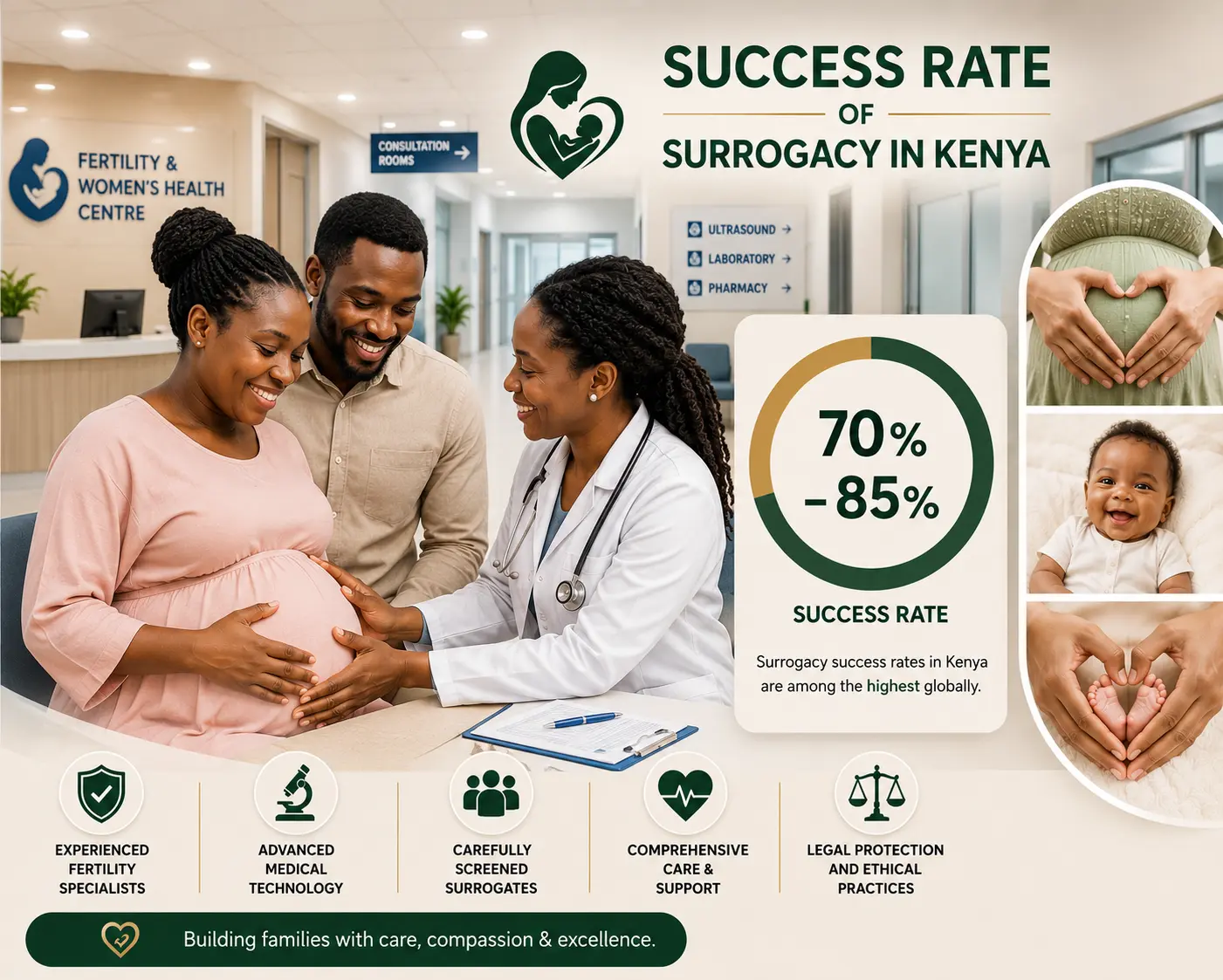
The success rate in Kenya generally stays high as compared to other countries in Africa. The success rate analysis presents live birth through gestational surrogacy, then through using egg donor which accrues more success than gestational surrogacy, live birth is around 95% and then a cumulative live birth is mentioned below which remains quite high in Kenya. An evidence-based surrogacy success rate is mentioned below.
| Outcome Measure | Success Rate |
|---|---|
| Live Birth Rate per Embryo Transfer (Gestational Surrogacy) | 41%–60% |
| Live Birth Rate per Transfer Using Donor Eggs | 50%–80% |
| Live Birth Rate After Confirmed Pregnancy | ~95% |
| Cumulative Live Birth Rate After Multiple Transfers | 85%–95% |
Factors Affecting Surrogacy Success
There are multiple factors which affect the success rate of surrogacy. The most important factor which affects success rate surrogacy is age, the more the age the more the success rate is affected, the younger the age the more is the success rate of the treatment. It remains a major factor affecting the success of the treatment.
Then comes the quality of embryo is an important factor which affects the success of the treatment, the most important factor affecting the success rate of the treatment depends on the quality of embryos since the embryos that is to be implanted in the uterus of the surrogate the whole procedure depends on this step and helps the procedure to go further successfully.
Genetic testing helps in determining if the embryos are carrying any genetic disorder which if not tested can have the risk of transfer to the child and avoiding the risk of transfer, genetic tests are undertaken. It helps in protecting future child. It involves the screening of the surrogate too.
Donor eggs are prescribed if the intended mother is suffering from any medical condition due to which they cannot provide their eggs for surrogacy so donor eggs are prescribed for surrogacy.
IVF lab quality also helps in the success rate for surrogacy. The lab should be well-equipped and have the latest technology which helps in getting successful treatment.
The health of the surrogate mother has the most important role determining the success of the treatment. If the surrogate has better health. If the surrogate mother is healthy the chances of pregnancy.
| Factor | Impact on Success |
|---|---|
| Age of Egg Provider | Most important predictor of success |
| Embryo Quality | Higher-grade embryos implant more often |
| Genetic Testing (PGT-A) | Can improve embryo selection |
| Donor Eggs | Typically achieve higher live birth rates |
| IVF Laboratory Quality | Better embryo development and selection |
| Surrogate Health | Healthy, previously pregnant surrogates have better outcomes |
Age-Wise Expected Success Rates (Using Own Eggs)
The expected age-wise success rate of surrogacy is presented. Under 35 years of age the success rate is comparatively higher. In women under 35 years of age women have a good ovarian reserve and egg quality. The chances of success rises when patientd go through these treatments at a young age. After a certain amount quality and quantity of eggs deplete.
Hence the chances of success too gets affected negatively over time. All it leads to the failure of the complete cycle. And in cases where the quality and quantity of eggs is so poor that can’t be used for the treatment then donor eggs are prescribed to them for treatment. So that the whole procedure can take place without failure.
| Age of Intended Mother at Egg Retrieval | Live Birth Rate per Transfer |
|---|---|
| Under 35 years | 50%–95% |
| 35–40 years | 35%–45% |
| Above 40 years | 20%–30% |
| Donor Egg Cycles | Up to 70%–75% |
Types of surrogacy and their success rates
| Surrogacy Type | Expected Success Rate |
|---|---|
| Gestational Surrogacy with Own Eggs | 40%–80% per embryo transfer |
| Gestational Surrogacy with donor eggs | 50%–90% per embryo transfer |
| Live Birth After Clinical Pregnancy | ~95% |
| Cumulative Success After Multiple Transfers | 85%–95% |
Laws regarding surrogacy in Kenya
The Assisted Reproductive Technology Bill (2022) is the bill for regulating surrogacy treatments. The laws regarding surrogacy in Kenya are quite progressive, since it allows heterosexual, married, same-sex couples, single parents and so on for getting surrogacy in Kenya. But only altruistic surrogacy is legally allowed. Commercial surrogacy is completely banned in Kenya. That is the restriction that the Kenyan government has put on surrogacy.
In terms of altruistic surrogacy the laws are quite lenient allowing surrogacy for all genders without any restrictions. International patients too can come for treatment without stress, proper planning and research can make the entire procedure accomplished with ease. Kenya provides Handles every step without any complex procedures be it medical or non-medical support. They handle every step professionally.
Who should go for surrogacy?
It is suggested to couples who cannot naturally conceive or carry pregnancy due to which surrogacy is prescribed to couples. And if planning for surrogacy abroad, surrogacy cost in Kenya is comparatively lower. There are multiple conditions due to which surrogacy is suggested and they are as follows.
- Absence of uterus or if the uterus is completely non-functional uterus. Or there are patients who are born with conditions where they are born without a uterus.
- There are multiple conditions such as Asherman’s syndrome, fibroids, and so on. Surrogacy is suggested for uterine abnormalities.
- Then for severe maternal medical conditions such as severe cardiovascular diseases, hepatic diseases, severe autoimmune disorders, cystic fibrosis.
- If there are recurrent failures of IVF or every other fertility treatments and the cause is not diagnosed or known then those patients are prescribed surrogacy.
- Same-sex couples and single parents can go for this treatment and Kenya allows them to get the treatment without any hassle since it is completely legal to go for surrogacy.
The Kenyan government does not put many restrictions for surrogacy. They are not required to go through multiple complex procedures and restrictions. Only commercial surrogacy is not legal in Kenya other than that altruistic surrogacy is completely legal to same-sex couples, single parents and heterosexual married couples.
Others countries than Kenya to consider for surrogacy
There are other countries to consider for surrogacy than Kenya and they are mentioned below with complete analysis including its advantages, cost and different eligibility. Surrogacy cost in Kenya remains relatively lower and stays a better option to go for.
| Country | Approximate Surrogacy Cost (USD) | Key Advantages | Considerations |
|---|---|---|---|
| Georgia | $45,000–$75,000 | Well-recognized international surrogacy programs, stays quite affordable, strong medical infrastructure | Laws can change; eligibility requirements should be verified before proceeding |
| Colombia | $55,000–$85,000 | comparatively costs than North America, growing reputation for fertility care | Legal framework is less standardized than in some destinations |
| Mexico | $60,000–$90,000 | Proximity for North American patients, experienced fertility centers | Surrogacy laws vary significantly by state |
| United States | $120,000–$250,000+ | Strong legal protections, extensive surrogate screening, highly regulated programs | Highest cost globally |
| Argentina | $60,000–$100,000 | Advanced fertility clinics and relatively affordable medical care | Legal procedures may vary depending on individual circumstances |
| Greece | $70,000–$110,000 | Established fertility sector, court-approved surrogacy process | Legal eligibility requirements apply to intended parents |
| Albania | $55,000–$90,000 | Emerging destination with competitive pricing | Fewer clinics and less long-term international experience than established markets |
IVF surrogacy clinic cost Kenya
IVF surrogacy clinic cost in Kenya is around $30,000 to $50,000 USD which if compared to western countries is still less. Western countries tend to charge more. Not only does surrogacy cost higher but other treatments too cost higher in these countries. And on top of that there are strict laws in these countries for these treatments. These procedures remain highly-regulated.
IVF surrogacy clinics cost Kenya relatively lower than other countries. And overall surrogacy cost in Kenya is even less compared to western countries. People travelling from foreign lands get confused over the cost of surrogacy treatments and for which country to choose for treatment. When coming to foreign lands there are multiple things to consider such as cost, success rates and location.
IVF & Surrogacy Clinic Cost in Kenya
- IVF treatment per cycle cost: USD 3,300–6,500
- IVF paired with ICSI treatment: USD 4,000–7,500
- Frozen Embryo Transfer (FET) treatment cost: USD 1,000–2,500
- Egg Donation treatment: USD 5,000–10,000
- Embryo Donation Program: USD 4,000–8,000
- Gestational Surrogacy Procedure requires: USD 35,000–50,000
- Cost of Guaranteed Surrogacy Package: USD 40,000–60,000
- Legal And Documentation Fees: USD 2,000–10,000
- Prenatal Care And Delivery: USD 12,000–18,000
- Cost of Travel And Accommodation: USD 2,000–5,000 (varies by duration of stay)
Typical All-Inclusive IVF Surrogacy Package in Kenya
- The IVF procedures and embryo transfers is included in and is the initial step.
- Fertility medications add to the cost of treatment.
- Surrogate matching and screening is a major step too.
- Pregnancy monitoring and screening.
- Prenatal care is the essential medical care that adds to the treatment.
- Delivery and hospital charges for the treatment.
- Legal agreements and documentations in Kenya have to be checked.
- Coordination and support is also essential for treatment and adds to the total cost.
Estimated Total Cost
- Standard IVF Surrogacy Journey: USD 40,000–55,000
- Premium/Guaranteed Programs: USD 50,000–70,000
Kenya remains one of the more affordable international surrogacy destinations, with total costs significantly lower than those in the United States and many European countries.
Why Choose Kenya for Surrogacy?
Kenya has come up and been emerging as a popular destination for surrogacy for international patients and the reason remains its relatively affordable treatment costs, highly skilled and experienced fertility specialists, and an access to the latest and advanced technology of assisted reproductive technologies which makes the whole procedure a lot easier. Even surrogacy cost in Kenya
Couples flying from abroad should try considering Kenya as an alternative option to more expensive surrogacy destinations because it helps in providing multiple number of fertility services which stays significantly lower cost.
The major reasons why intended parents choose to come Kenya for the surrogacy include:
- Cost-effective and affordable Surrogacy Programs: Surrogacy in Kenya stays mostly more affordable and is generally more cost-effective than in countries such as the United States, Canada, and several European nations.
- Fertility Clinics Which Comes with Experience: There are fertility centers in Kenya which provide treatments such as IVF, ICSI, embryo freezing, genetic testing, and donor programs which help by using internationally recognized and established medical standards.
- IVF and Egg Donation Access and helps easing procedure: It gives you the choice to combine surrogacy with egg donation, sperm donation, or IVF treatment when required.
- English-Speaking Medical Environment: The communication problem is a major issue for people coming from different countries and for that English is widely used in healthcare settings, making communication easier for international patients.
- No Long Waiting Times: There are countries which have longer waiting times and then comes the most important stage which is the surrogate matching and it can take many months, there are chances of Kenya offering a faster process depending on surrogate availability.
- An Extended Care Packages: There are multiple clinics that offer all-inclusive programs which makes the process easier by covering IVF procedures, surrogate compensation, pregnancy monitoring, and delivery-related expenses.
- Growing Medical Tourism Sector: Kenya has become a well-established and well-recognized destination for fertility and reproductive treatments, attracting patients from Africa, Europe, Asia, and the Middle East.
- Latest and Modern Healthcare Facilities: There are a number if major cities such as Nairobi and Mombasa which work as a welcoming host fertility centers equipped with advanced reproductive technology and specialized fertility teams.
Guaranteed Surrogacy Programs in Kenya: Are They Worth It?

Guaranteed surrogacy programs in Kenya that are specially designed to lower the overall financial burden and emotional uncertainty associated with traditional surrogacy arrangements. Since there are instances where there are requirements for repeating a certain procedure or doing the whole procedure again then that adds to the already high cost of treatment. But still compared to other western nations, surrogacy cost in Kenya remains lower.
In contrast to standard programs, these are packages which often include a number of embryo transfer attempts, and there are multiple different methods which are then required during the whole procedure that have to be done multiple times. Surrogate rematching is a procedure that sometimes has to be practised if required, and continued treatment support until a successful pregnancy or live birth, depending on the terms of the agreement.
What Does a Guaranteed Surrogacy Program Usually Include?
Most guaranteed surrogacy packages may offer:
- A number of multiple IVF and embryo transfer attempts.
- The next step is for surrogate mother matching and replacement if required.
- This requires an essential medical screening and fertility testing.
- The need for pregnancy monitoring and prenatal care.
- The requirement for legal documentation and coordination.
- The case management and patient support is also important.
- Expenses regarding the major step which is for delivery.
- In some programs, a live-birth commitment or partial refund policy if agreed outcomes are not achieved
Advantages of Guaranteed Surrogacy Programs
| Benefit | Why It Matters |
|---|---|
| Reduced Financial Risk | There are several treatments attempts are mostly covered within a single package. |
| Greater Predictability | Parents can better estimate the total cost of treatment. |
| Higher Peace of Mind | Complete support and care is continued all throughout the surrogacy procedures. |
| Access to Advanced IVF Techniques | A diverse range of programs include embryo screening and modern laboratory procedures. |
| Fewer Unexpected Expenses | There are packages that consist of multiple medical and handling and coordination costs which come into the package. |
Potential Drawbacks to Consider
There are multiple drawbacks associated with these treatments that are important to consider if choosing to come to Kenya. This has to be an essential aspect to consider. Those potential drawbacks to consider are as follows:
| Consideration | Explanation |
|---|---|
| Higher Upfront Cost | Since guaranteed programs generally cost more than standard surrogacy packages. |
| Terms and Conditions Apply | No medical treatment guarantees results and it may be linked to specific medical criteria and treatment protocols. |
| Success Cannot Be Truly Guaranteed | The live birth depends on multiple factors and there are instances where even the best fertility clinics cannot promise a live birth in every case. |
| Package Exclusions | Certain services, medications, travel costs, or neonatal care may not be included. |
Are They Worth It?
For intended parents where they have experienced a number of failed IVF cycles, the advanced maternal age is also a major factor that is usually is taken into consideration for the recurrent pregnancy loss, or those travelling internationally, a guaranteed surrogacy package can provide greater financial protection and reassurance. Patients get relieved with the additional financial burden and the whole procedure runs smoothly. The ability to access multiple treatment attempts under a single agreement may ultimately prove more cost-effective than paying separately for repeated IVF and surrogacy cycles.
However, it is important to go through and review the contract carefully. There is a common confusion among patients when they go for this treatment package, The term “guaranteed” itself does not always suggest a clinic can ensure a successful live birth. Instead, most of the time it only refers to additional treatment attempts, surrogate replacement, or there are only specific refund provisions if agreed milestones are not met. Intended parents are required to thoroughly evaluate program inclusions, exclusions, clinic success rates, and legal protections before making a decision.
Is Worth Coming to Kenya for Surrogacy?
A guaranteed surrogacy program in Kenya may be worth for intended parents going for greater cost stability and reduced treatment risk. While these programs has to typically require a larger initial investment, they can offer valuable protection against the financial burden of multiple failed treatment cycles when provided by experienced fertility providers.
How Long Does the Surrogacy Journey Take in Kenya?
The entire surrogacy journey in Kenya usually takes around 12 to 18 months, although the exact timeline tends to vary highly depending on factors such as surrogate availability, IVF success rates, medical requirements, legal procedures, and whether donor eggs or sperm are needed. Intended parents who already have frozen embryos may experience a shorter timeline, while those requiring IVF cycles, genetic testing, or donor programs may need additional time.
| Stage | Estimated Duration |
|---|---|
| Initial Consultation and Medical Evaluation | 2–4 weeks |
| Surrogate Matching and Screening | 1–3 months |
| Legal Agreements and Documentation | 2–6 weeks |
| IVF Cycle and Embryo Creation | 1–2 months |
| Embryo Transfer Preparation | 2–4 weeks |
| Embryo Transfer and Pregnancy Confirmation | 2–3 weeks |
| Pregnancy Monitoring and Prenatal Care | 9 months |
| Delivery and Post-Birth Formalities | 2–8 weeks |
Factors That Can Affect the Timeline
Several factors may influence how long the surrogacy process takes:
- Availability of a suitable surrogate mother
- Need for egg donation or sperm donation
- Number of IVF or embryo transfer attempts required
- Embryo genetic testing (PGT-A/PGT-M)
- Medical conditions affecting fertility or pregnancy
- Completion of legal and administrative requirements
- Travel arrangements for international intended parents
Can the Process Be Completed Faster?
In some cases, intended parents who already have cryopreserved embryos and are matched quickly with a surrogate may complete the pre-pregnancy stages within a few months. However, since a successful pregnancy itself requires approximately 40 weeks, most surrogacy journeys still take at least one year from start to finish.
Planning for International Patients
International intended parents should also account for additional travel, documentation, and post-birth procedures. Depending on nationality and embassy requirements, obtaining the newborn’s travel documents and completing parental registration may add several weeks after delivery.
Conclusion
Most intended parents should expect a surrogacy journey in Kenya to take 12–18 months, with the pregnancy period accounting for the largest portion of the timeline. Careful planning, choosing an experienced fertility clinic, and having embryos ready in advance can help streamline the process and reduce delays.